
Press Release: NEW RESEARCH SHOWS COST OF JUNE 2026 HEATWAVE AT LEAST £2.4bn
Credit: Met Office
PRESS RELEASE: FOR IMMEDIATE USE
NEW RESEARCH SHOWS COST OF JUNE 2026 HEATWAVE AT LEAST £2.4bn
Think tank estimates future costs of heatwaves to 2030 at least £25bn
The record-breaking June 2026 heatwave saw temperatures exceeding 37 degrees in parts of the UK, with direct economic consequences as exceptional temperatures make work harder to perform. The well-documented impacts of extreme heat on productivity include the physical difficulties of performing work and cognitive impairment, as well as the damage done to physical infrastructure and equipment. An extended period of extreme heat, as we saw in June, will compound these economic losses.
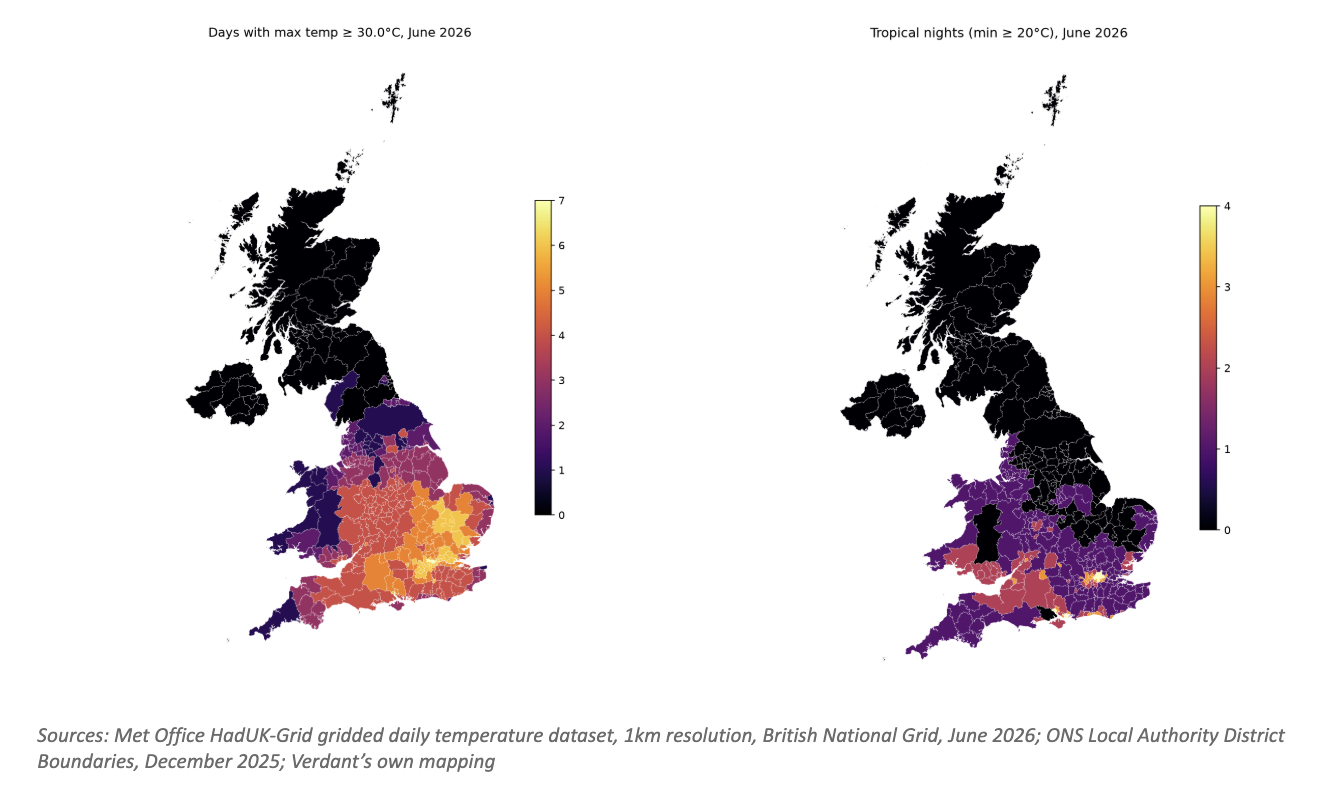
Verdant, an economic-policy focused think tank, has produced a first estimate for the likely economic impact of the extreme heat in the June 2026 heatwave, based on research showing 30 degrees as a crunch point after which productivity losses become more severe. The graphic shows Verdant’s mapping of UK local authority areas with days above 30 degrees in June. The direct impact on UK productivity alone of this extreme heat cost at least £2.4bn in lost output.
With a third heatwave already hitting the UK and much of Europe in July, we can expect further losses over this year. Looking ahead, and assuming heatwaves develop annually on the same trends as over the previous decade, these losses will become very substantial. By the end of 2030, we expect output losses alone from heatwaves will come to at least £25bn, if action is not taken to reduce their impacts.

These are the losses only from reductions in productivity as a result of extreme heat. They do not include the potential losses from rising energy costs, or the longer term impacts on investment, the broader macroeconomy. As a result, these losses should be considered a minimum expected loss from extreme heat.
The Committee on Climate Change has recommended an expenditure of £3.85bn a year, on average, on measures to adapt to the effects of extreme heat over the next few decades. These expenditures will need to be made by government, and by firms and households, and include the provision of air conditioning in public buildings.
Importantly, these projected costs are significantly lower than the expected (minimum) losses from extreme heat, which are likely to rise rapidly every year until the end of this decade and beyond. The case for investment in adaptation is economically robust.
Verdant make four main policy recommendations, following other work:
A national maximum working temperature, as recommended by the Committee on Climate Change and as already implemented in Spain and Belgium;
A novel national heat insurance mechanism, paid out to those unable to work when temperatures exceed a maximum, and financed potentially through an Extreme Weather Levy on fossil fuel investments;
Investment in active cooling, with healthcare settings as a public priority, but across indoor workplaces, and paired to renewable generation where possible;
The redesign and replanning of our urban environments to reduce their heat sink effects, including greening urban spaces, mandatory passive cooling in new builds and renovations, and the provision of public cool spaces.
Dr James Meadway, co-director of Verdant, said:
“These first estimates show the economic costs of extreme heat are already here, and only likely to worsen. Urgent action is needed from government to limit the damage, including protecting those at work with a maximum working temperature.”
ENDS
For further comment, contact James Meadway: james@verdantthinking.org / 07894953555
NOTES:
The accompanying policy briefing “The Price of Heat: What June 2026 Cost the UK” contains the full details of methodology and sources: https://www.verdantthinking.org/publications-and-events/the-price-of-heat
The critical point of 30 degrees, after which productivity losses become apparent, is based on empirical estimations of European output and temperatures since 2011, with results reported by Allianz, “Too Hot to Grow”, May 2026. https://www.allianz.com/en/economic_research/insights/publications/specials_fmo/260528-heat-economics.html
Verdant’s mapping of heat onto local authority areas is taken from data in Met Office HadUK-Grid gridded daily temperature dataset, 1km resolution, British National Grid, June 2026; ONS Local Authority District Boundaries, December 2025; and ONS’ local authority GVA measures.
Verdant is an independent think tank committed to a just and green future, launched in May 2026.