
Heat pump spending cuts mean cutting support for a new industry just when it’s most needed
Heat pumps. Source: Magnific
James Meadway
The Guardian reports that the government is looking to slash hundreds of millions of pounds from its £2.7bn “Boiler Upgrade Scheme” that provides subsidies for households looking to upgrade their old boiler to a new, low-carbon heat pump. Scrabbling around for cash to fund its questionable plans to ramp up defence spending, cutting subsidies for heat pumps at a critical stage in the development of the UK industry is a classic piece of Treasury short-term thinking. If the cuts go ahead, jobs will not be created in an industry with the potential for rapid growth – and one that is urgently required to meet not only the needs to decarbonise our housing stock, but to prepare it for the extreme heat of summers to come.
The scheme is simple. The government pays part of the cost of swapping a gas, oil or LPG boiler for a heat pump: £7,500 for most homes, and £9,000 for homes off the gas grid. You apply through an installer, who takes the grant off your bill. So far it has paid for 79,704 heat pumps. Government evaluators found that about three quarters of these would not have happened, or would have been delayed, without the grant.
A fridge in reverse
A heat pump works like a fridge in reverse. It uses electricity to move heat from the air or ground outside into your home, instead of burning gas or oil. The government says it is about three times as efficient as a gas boiler. Many can also run backwards in summer to cool your home. Not every model can, as Which? explains, but the scheme now also funds air-to-air units, which heat and cool. The Climate Change Committee warns that 92% of homes could overheat in future heatwaves, and that heat-related deaths, now 1,400 to 3,000 a year in heatwaves, could reach 10,000 a year by 2050.
Heat pumps are harder to install than a boiler. The government admits they can take longer, cause more disruption and need extra paperwork. They also cost more: a typical air-source heat pump cost £12,850, so even a £7,500 grant leaves a big bill though not dissimilar to installing a traditional boiler. Installations jumped after the grant went up in 2023, from 13,735 in 2023/24 to 31,018 in 2025/26. Most installers are small firms, and colleges will not train for a market that doesn’t yet exist, argues the Aldersgate Group. The government expects costs to fall as the market grows. Meanwhile, one-third of heat pumps installed in the UK are made here, and the government, before this cut, aimed to increase that figure to 70%. A bigger domestic market would support more jobs in installation and manufacturing.
This is where a subsidy comes in: it supports the initial demand, when the technology is still pricey, and in doing so encourages more investment, driving innovation and falling prices. It’s this basic mechanism that has today seen extraordinary improvement in China’s solar photovoltaics, for example. It’s a classic case of “infant industry” protection, of the kind economist Ha Joon Chang argues for.
There is very significant room to grow the market. Government plans illustrate heat pumps rising from 0.5 million homes in 2025 to 2.5 million by 2030, and its Clean Energy Jobs Plan sees heat and buildings jobs growing from 66,000 to 248,000. Aldersgate says installations must rise from 73,000 in 2024 to 450,000 a year by 2030. The industry’s trade body, the Heat Pump Association, expects installation and servicing jobs rising from 8,080 in 2025 to 45,166 in 2030, if demand is there.
Heat pumps – a rural endeavour?
So where has the money gone? The map shows grants by local authority.
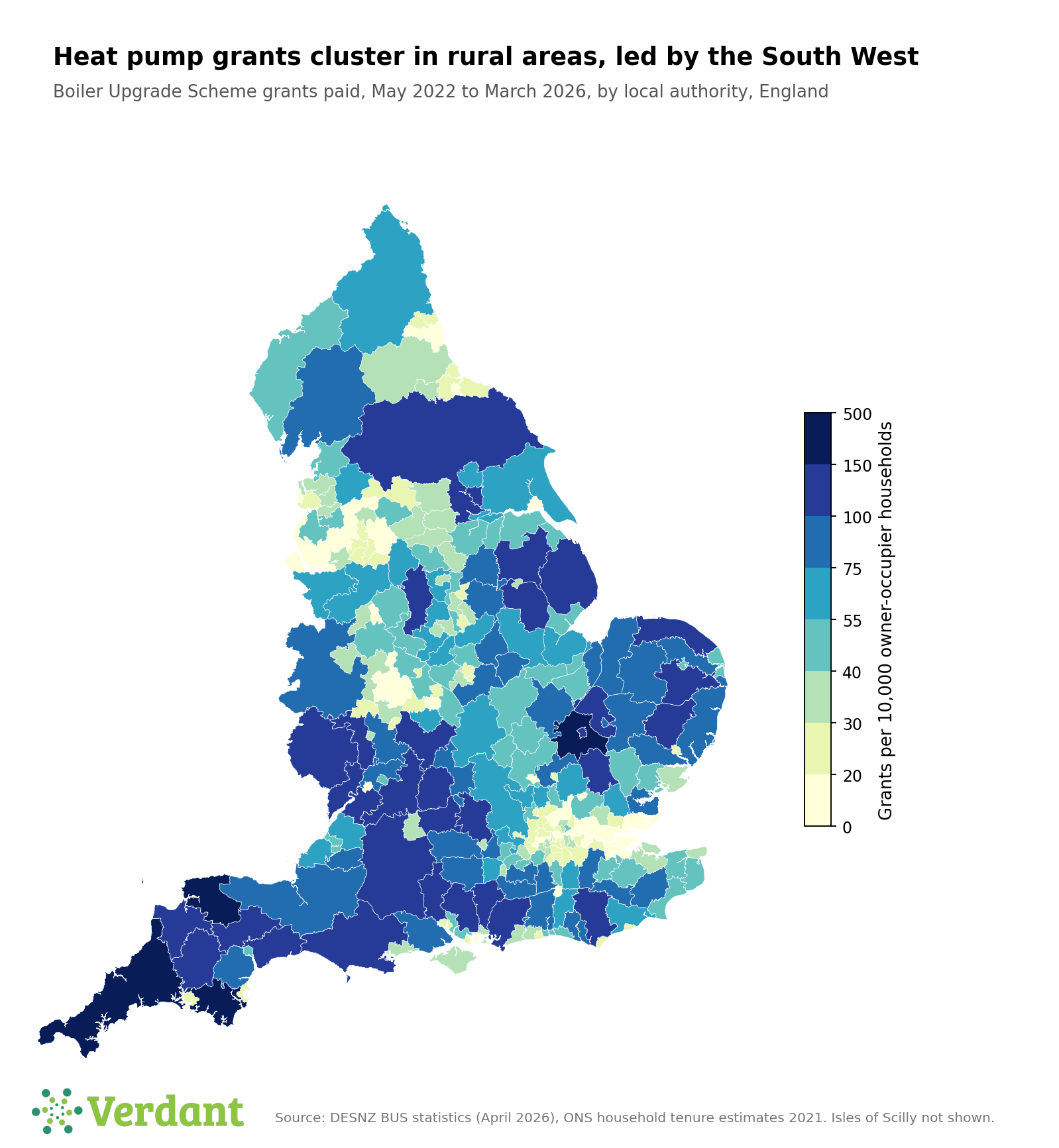
Grants per 10,000 owner-occupied homes, England, May 2022 to March 2026. Source: DESNZ, ONS; author’s calculations.
Take-up is highest in rural areas such as the South-West, the East and North Yorkshire. The most rural fifth of local authorities had about 100 grants per 10,000 owner-occupied homes, the most urban fifth just 23. Homes off the gas grid, mostly rural, have most to gain: the grant is bigger, and one in five grants replaced oil, LPG or coal. Homes on the gas grid, mostly in towns, face a different calculation. The government acknowledges that the UK’s pricing system makes residential electricity costly relative to gas, compared to other European countries. Fixing the UK’s broken household energy market, for example in breaking the link from electricity prices to gas generation, would help here. And the evaluation found that many owners of older homes believe heat pumps only suit newer, well-insulated ones. So a cut hits rural England hardest.
But the map shows where the scheme has fallen short. Most of us live in towns and cities, and the government needed to push harder there, not less. It is starting to work: the rural share of grants fell from 58% to 46% in the three years to 2026. Heat pumps are still rare: the English Housing Survey finds that just 1.1% of English households, about 1 in 90, have one, and the poorest fifth are least likely to. Take-up has also leaned towards the better off, with 56% of recipients earning over £52,000. But it is worth noting that median household income amongst owner-occupiers in England and Wales is £54,740. This was hardly a giveaway for the supe-rich. And the consumption pattern is normal for a technology in its early stages of diffusion: the first buyers are richer, then costs fall. The answer is more help, not less.
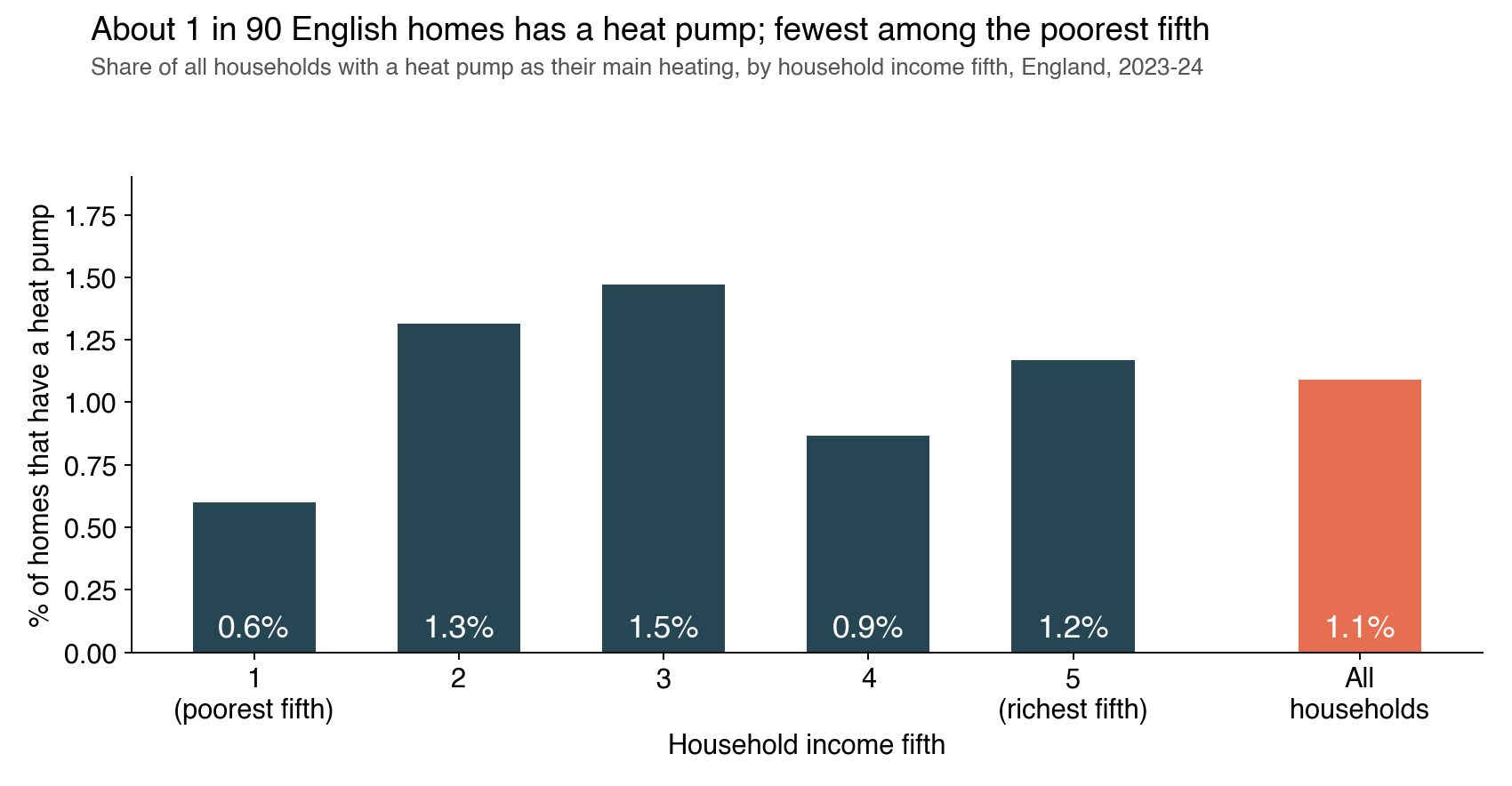
Share of all households with a heat pump as their main heating, by household income fifth, England, 2023-24; the final bar is all households. Source: English Housing Survey 2023-24, Annex Table 2.
The need will grow. The Climate Change Committee estimates the UK must invest at least £11 billion a year more to adapt to climate change, and roughly a third of that is for cooling. Cooling measures return about £3 for every £1 spent, argues the Committee, and heat pumps that can cool could be backed through existing schemes. Like heat pumps, cooling will need subsidy to get going. Just over 4% of UK homes currently have air conditioning. And after this summer’s heatwaves, which Verdant estimated cost the UK economy an unprecedented £4.4 Bn over just a few weeks, it’s short-sighted to ignore this need that is only going to get worse. There are other knock-on impacts too – like rising social care costs for elderly people living in homes that are just too hot. Heat pumps respond to that need.
The right jobs at the right time
Government modelling says the grants supported about 800 jobs a year in 2022 to 2025, and the Heat Pump Association estimates there are 8,080 installation and servicing jobs in the industry in 2025. But the bigger loss would be jobs never created: the HPA projects about 37,000 more jobs by 2030. Given the Burnham and Healy’s stated aim to reindustrialise Britain and create jobs, it’s a peculiar choice to switch funding out of heat pumps for the dubious economic benefits of defence expenditure.
There’s some uncertainty about the size of the mooted cuts, but let’s assume they want to scrape off £100m. At the scheme’s average cost of £6,680 a grant, that is about 15,000 grants, and about 11,000 are installations that would never happen, because 74% of grant-funded installations were found by the evaluators to be additional. Using government and industry estimates of jobs per installation, each £100 million cut costs roughly 540 to 930 job-years. At £500 million, spread over three years, that is 900 to 1,550 jobs a year, occurring at the exact moment the industry could be achieving take-off – so creating not only a loss today, but undermining the future potential of the industry, as those jobs not created means fewer opportunities to learn on the job or to support broader training and investment across the whole supply chain.
The government wants to cut a subsidy for an industry that could bring thousands of new jobs, genuinely tackles the climate crisis, adapts people’s homes to deal with the extreme heat, reduces long-term costs to the economy and increases comfort for householders.