
What the Green rent brake would be worth

Photo by Jakub Żerdzicki on Unsplash
James Meadway
At Green Party conference in Brighton, Zack Polanski proposed a three-year emergency brake on private rents: rents could rise by no more than the lowest of 2%, inflation, or wage growth, with a permanent Fair Rents Guarantee to follow. It borrows the machinery of the pensions “triple lock” and turns it upside down – pensions rise by the highest of the three; rents can only by rise by the lowest.
Renting in England has been getting less affordable for a decade. Savills put the average renter's outgoings at 32.4% of gross household income in 2025, up from 30.4% five years earlier, which is the sharpest deterioration in rental affordability since at least 2006. Average rent across England reached £1,451 a month in July and is still climbing at nearly 4% a year. Renters typically pay more than two-fifths of their income in rents, and almost half in London.
Why 2% is the number that matters
The limit that binds is whichever is lowest in any year. On the major current forecasts that is the flat 2%. The Office for Budget Responsibility thinks inflation will be at 2.0% from 2027 and earnings growth will vary from 2.1% to 2.4%. The independent forecasters compiled by the Treasury are higher still, averaging 3.2% earnings growth in 2027 and 3.1% in 2028, with not one of the sixteen forecasters surveyed below 2.8%. Nobody expects pay rises or inflation to drop under 2%. Looking at the news, it’s reasonable to expect inflation to be above 2% for some time to come.
So we have assumed the 2% limit is the rent rise limit in all three years, and rents rise by a flat 2%. The savings that the scheme produces are then relative to what the estate agent JLL thinks will happen to rents over the next three years. Their forecasts show rents rising by 9.6% nationally over the next three years. The difference between that forecast and the capped rent is the saving to a renter.
These are the smallest savings the brake can produce. The rule takes the lowest of the three measures. If inflation or wage rises are higher, the cap doesn’t change. Only if one of them falls below 2% would anything change, and that would push the cap down, and the relative saving up. There is no path on which renters do worse than the figures below.
How much renters will save
Over the three years the average private renter in England would avoid paying at least £884 — £4.2bn nationally. The median local authority is £743.
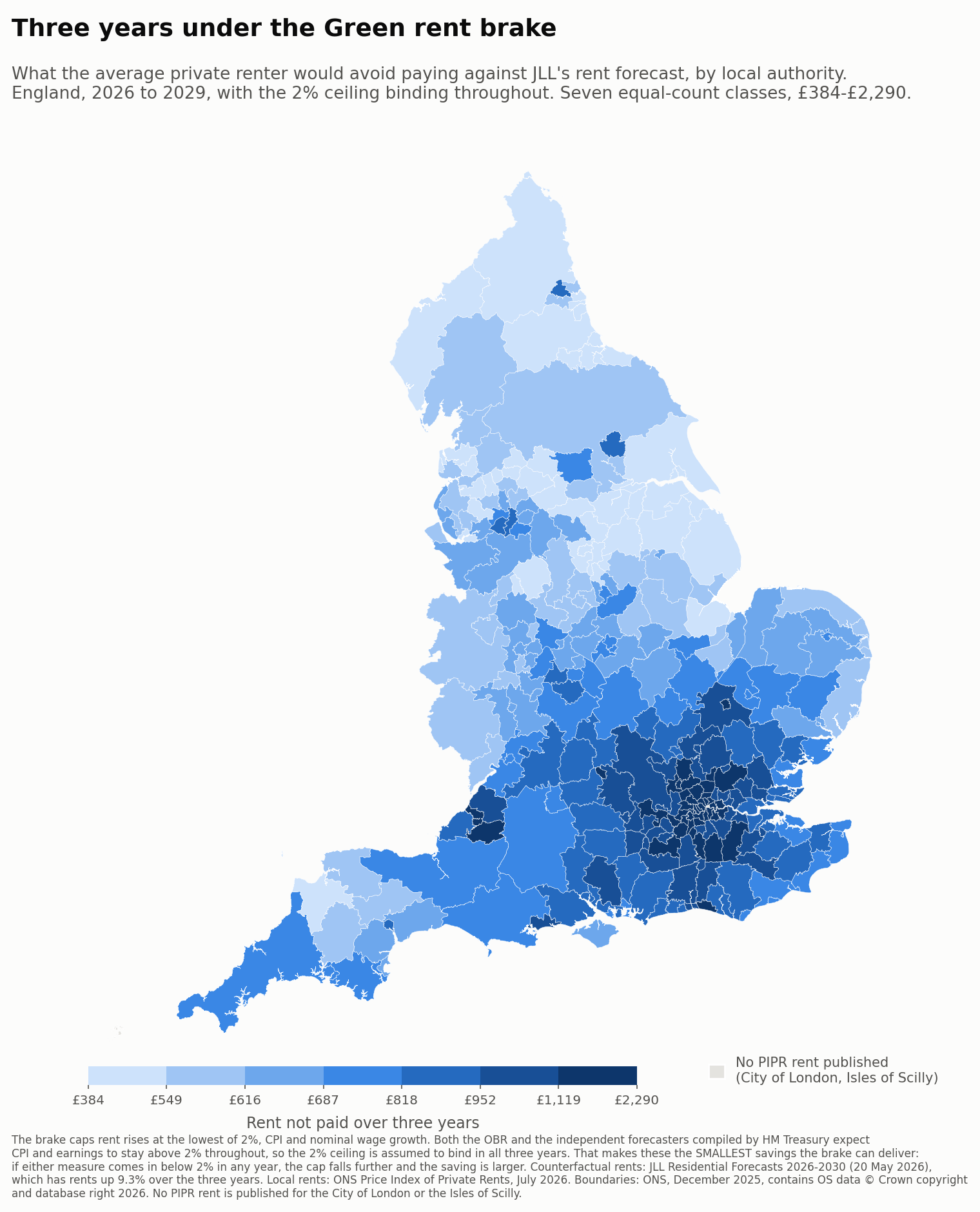
Rent not paid over three years, by local authority, with the 2% ceiling binding throughout.
It rises from £384 in Hartlepool to £2,290 in Kensington and Chelsea. By size of home it is £642 for a one-bed and £1,346 for four or more.
The biggest savings are in London
London renters would keep on average £1,381 each, or £1.41bn in total across the capital — a third of the England total, despite London only having a fifth of England’s rented households.
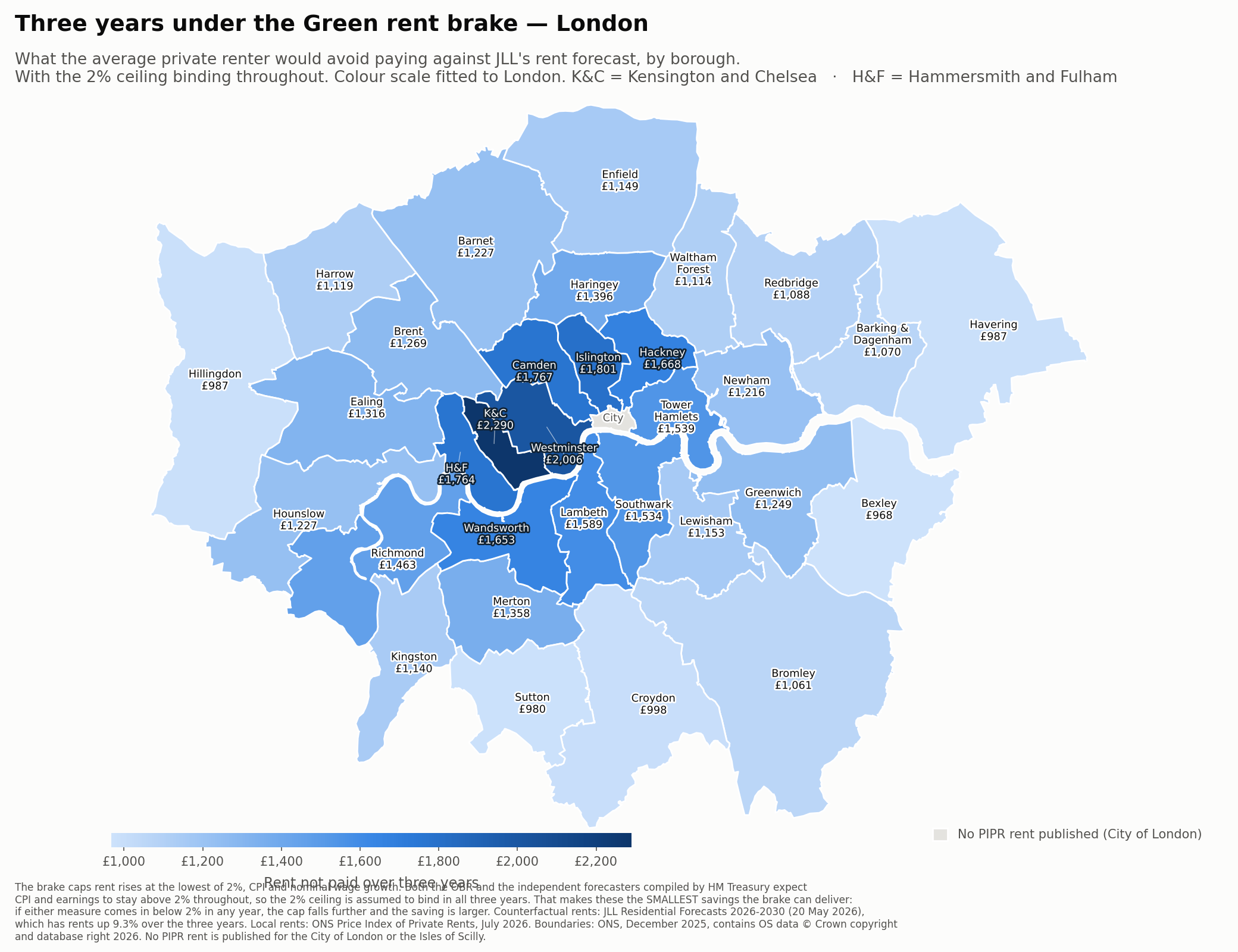
Rent not paid over three years, by London borough. Colour scale fitted to London.
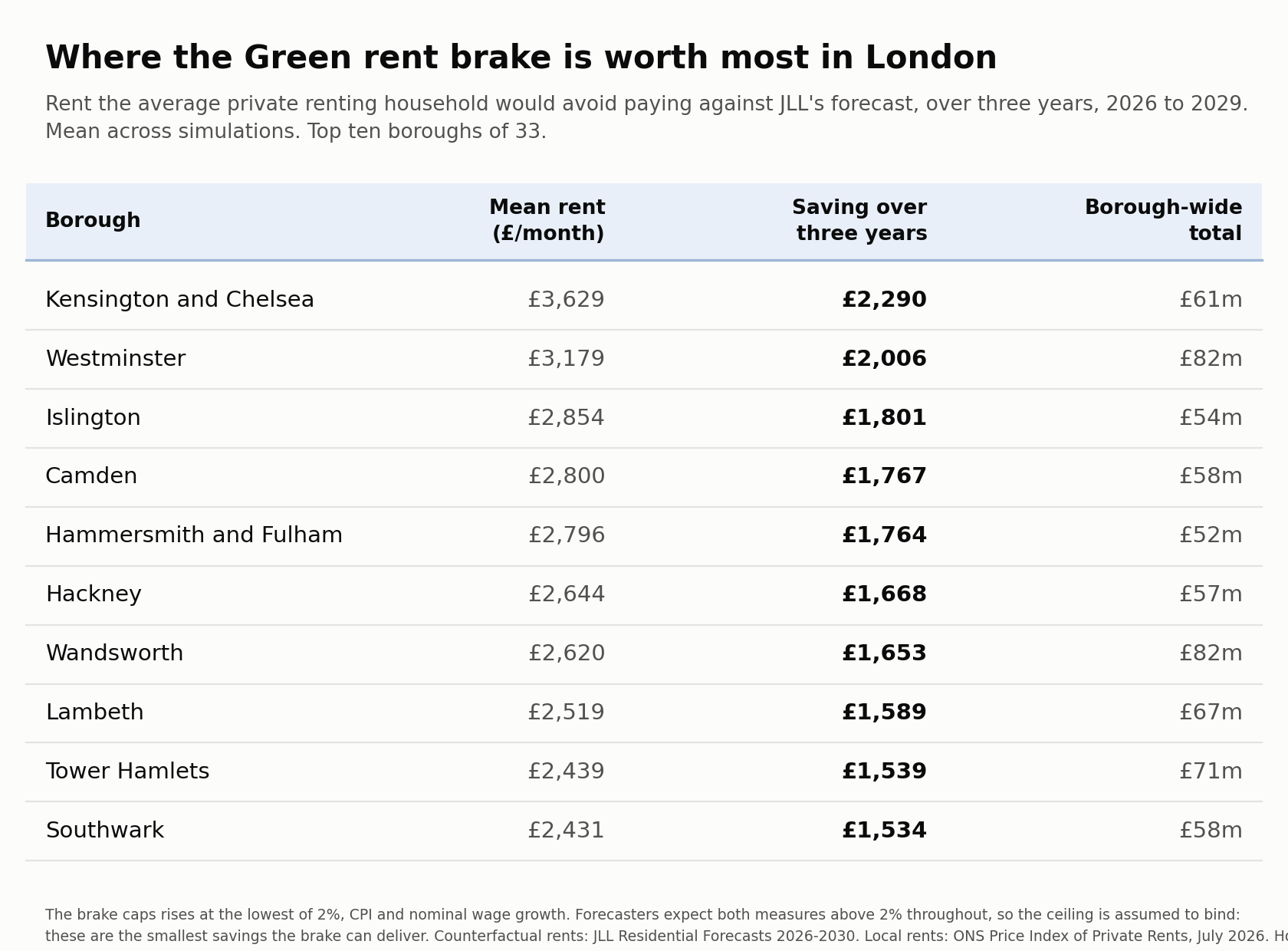
Savings are most significant in central-east London. Westminster renters save just over £2,000, whilst those in Camden could expect to pay £1,767 less.
Sources: Rents: ONS Price Index of Private Rents, July 2026, and JLL Residential Forecasts 2026–2030. Inflation and earnings outlook: OBR Economic and fiscal outlook, March 2026, and HM Treasury, Forecasts for the UK economy, August 2026. Households: Census 2021. England only. Full workings available on request.