
Can changing the triple lock pay for care, and who gains if it does?

James Meadway
Andy Burnham made some big pitches in his well-received speech at Labour conference last week. At the centrepiece was his call for a complete overhaul of Britain’s social care system, which provides care for those who need it typically later in life. This is, notoriously, a mess, and one that leaves some very vulnerable people exposed: Age UK estimates that two million pensioners currently go without having their care needs met. For those who are able to access care, rising costs have often meant using a family home to pay, or using the meagre State pension to pay for care charges. Burnham plans a sweeping overhaul of the system to create a National Care Service providing free personal care for older people, funded by reforming the “triple lock” on the State pension from April 2030. Burnham compared it to the creation of the NHS.
It’s a bold plan. Burnham has staked his, and his government’s reputation on delivering it. But it raises two questions: can the triple lock reform pay for a National Care Service? And who gains (or loses) if it does?
Below we show one way to answer the questions. By itself, the triple lock reform will not pay for the National Care Service on any reasonable timetable – not, if we are lucky, inside of twenty years from now. And tweaking the triple lock is unambiguously regressive, with lower income pensioners losing proportionately more. Nor is it intergenerationally fair: younger people today lose more overall than older people. But introducing the National Care Service itself could be a huge boost to the millions currently not having their care needs met, who are particularly likely to be poorer pensioners.
1. Is it affordable?
The current triple lock raises the state pension by the highest number of either inflation, wage growth or a fixed 2.5% “floor” every April. This means that whenever inflation or the 2.5% floor is higher than wage growth, the pension is increased faster than ahead of earnings. The new version will pay at least inflation or 2.5% a year but will recover any lead over earnings only later, so the pension tracks average pay over time.
Savings for government (relative to the old system) start to appear if wages fall behind inflation, and then recover. Under the old triple lock, a single year with unusually rapid inflation, for example, will impose additional costs for government as pension payments rise in line with them. These additional costs will be magnified if, in the following years, wages then rise rapidly to catch up with past inflation. This is the so-called “ratchet” effect of the old system.
The new system removes that catch-up element, and this is where substantial government savings might start to appear. Eventually, the new scheme will have saved enough money, relative to what the original would have paid, that it makes the change to free personal care affordable. We can predict the year when this happens.
But this dependency on wage growth and inflation makes the future costs of the new scheme, relative to old scheme, a little uncertain. We don’t know what course future inflation and wage growth will take in any given year, even if we think we know their long run average growth rate.
So as well as the average growth rate of both wages and prices, the specific path from now into the future of wages and prices also matters for working out the potential savings of the new system. What specific growth rate either reach in any given year matter more for how much is paid out each year than their long-run average growth rate.
Modelling the impacts
To get round this uncertainty, we can simulate many, many different paths for both earnings and wages to take from now into the future. The model has both factors wobbling around their long-run growth paths, so that in any given year either may be above or below that average rate of growth. In the graph drawn below, we assume that inflation averages 2%, and wages rise 3.5%. These are the same as the Office for Budget Responsibility’s (OBR’s) long-run assumptions.
I compared the savings with three costs: full free personal care at the Health Foundation’s estimate of about £7.5bn a year for a Scottish-style scheme, assumed to be the same amount every year; the same provision, but now with costs rising each year with the OBR’s projections for an ageing population; and an illustrative first stage, abolishing council care charges for over-65s, at about £1.1bn. For comparison, the government has indicated it believes the new scheme will save £15bn by 2030, and £50bn by 2050.
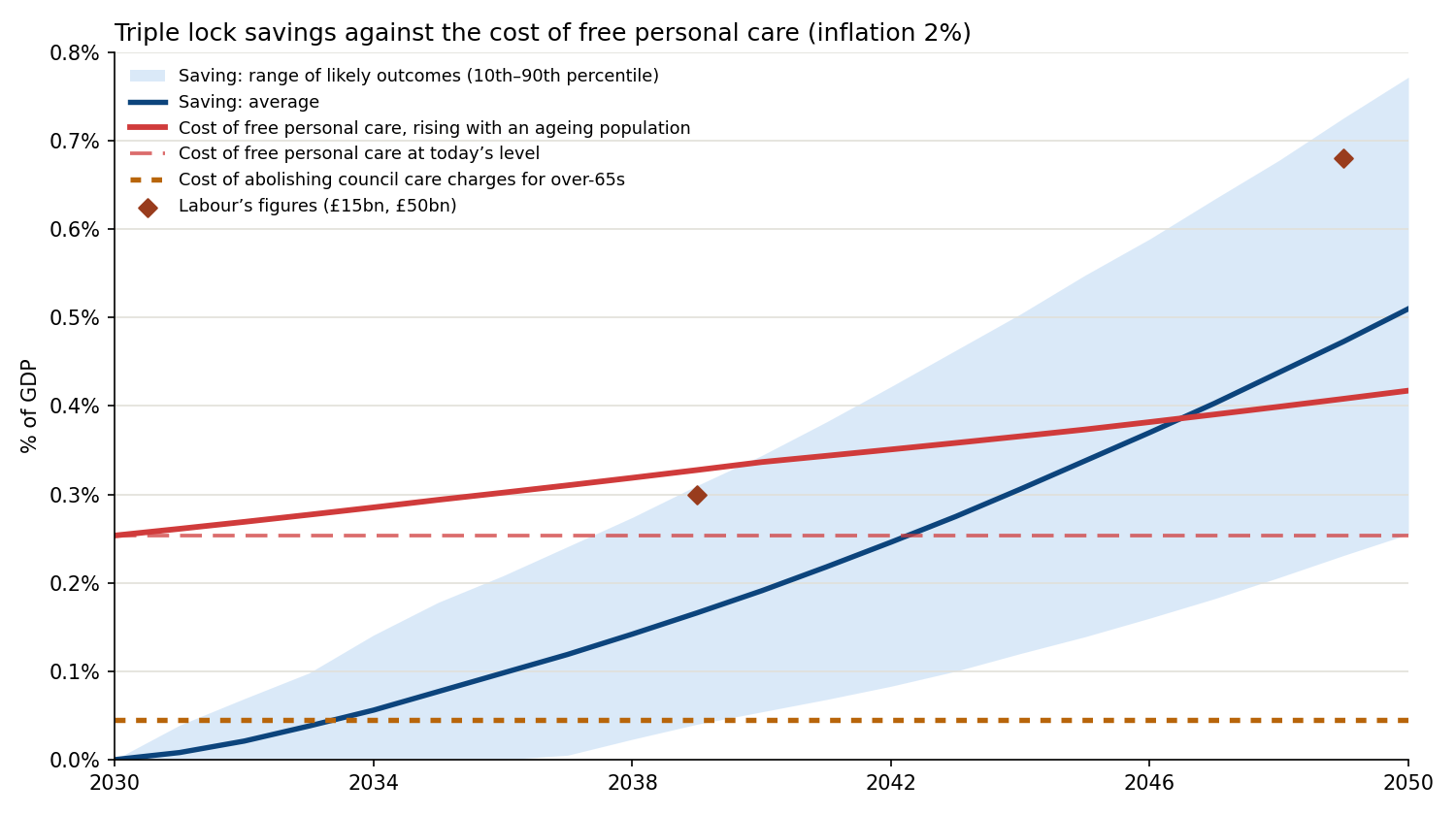
On the central path (the dark blue line) the reform saves little before the mid-2030s. It covers the narrower first stage from around 2034, but full free personal care from about 2043 at today’s costs, or 2047 if costs rise in line with OBR forecasts for the elderly population (to around £14bn in today’s money).
The lighter blue area around that central path shows the range over which 90% of those random other paths will vary. It shows the very broad range of what we should expect to happen in the future, given our long-run assumptions about wage rises and inflation. The dark blue line is the most likely outcome path; the light blue area shows the others around it.
Labour’s £15bn and £50bn figures are shown with orange diamonds. We can see straightaway that they are not very likely to be met – there is a roughly one in eight chance of reaching either, in our modelling. On the government’s own central assumptions about the future, it is likely to be two decades before the triple lock reduction could be claimed to be funding free social care.
Different scenarios for future inflation and wage rises
These assumptions about the long run behaviour of wages and prices might be wrong. Inflation might be much higher or lower in the future, whilst wages might grow faster or slower. That, in turn, determines whether the 2.5% “floor” kicks in, and this is critical to how many savings we get from the system. Looking at different inflation rates, but keeping wage growth unchanged, full free personal care becomes affordable if:
Inflation is at 3%: about 2043 at today’s cost, or 2048 at rising costs.
Inflation is at 4% or 5%: about 2045 at today’s cost; not by 2050 at rising costs.
The heatmap shows, for 56 combinations of inflation and wage growth, the first year in which the average saving covers full free personal care at rising cost, again looking at the same random paths for wages and prices through time. The outlined cell is the central case, as we showed above on the graph.
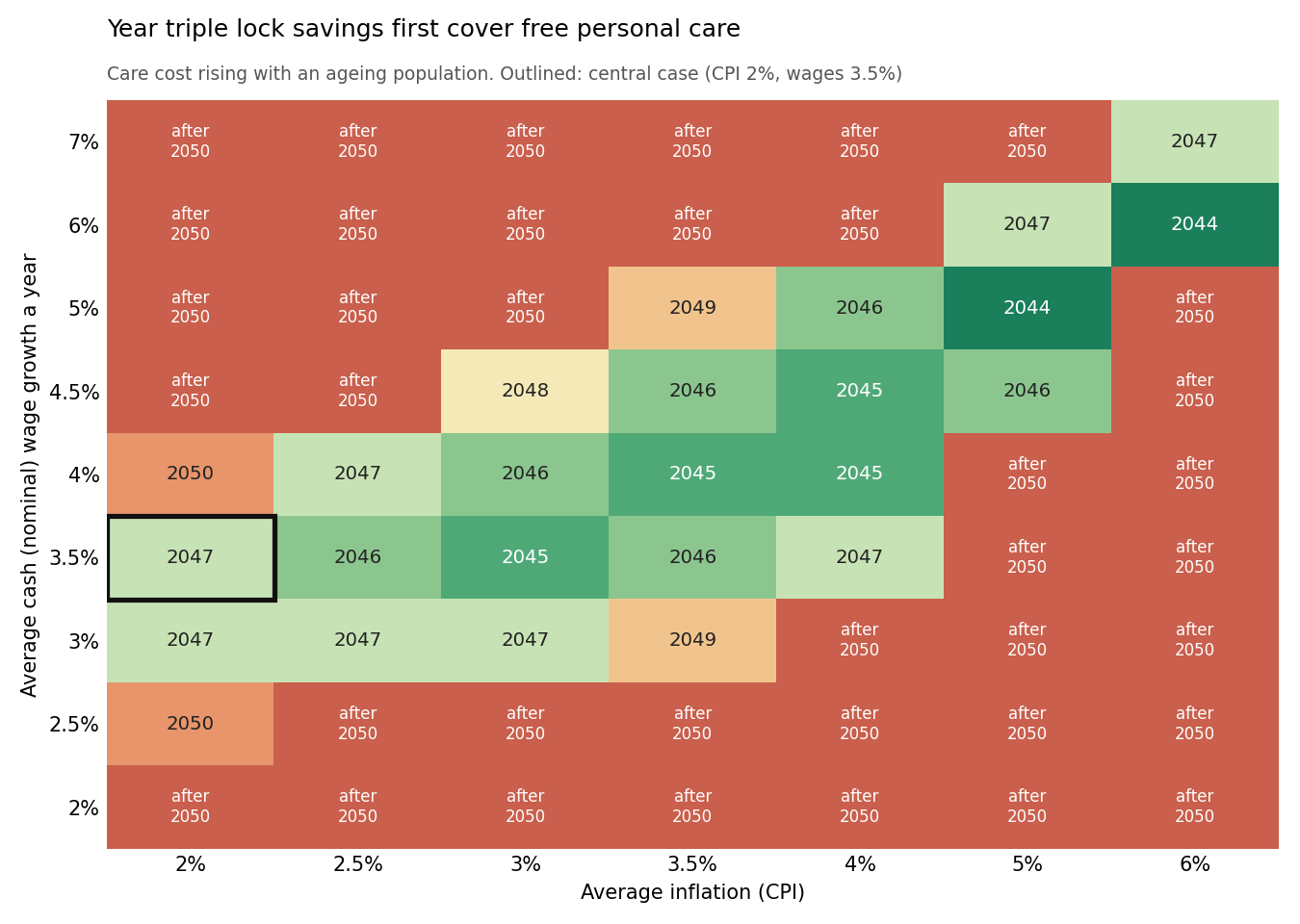
Affordability comes soonest when wages grow no more than 1% above inflation. Any more or less than that, and affordability is pushed well off into the future. In other words, if the future is much like the past, with relatively low inflation and modest real wage growth, the tweak to the triple lock system eventually produces savings – eventually, but not until xxx at the earliest. This is the government’s central economic forecast.
But there are significant dangers here. Climate change and geopolitical instability both make future inflation most likely higher on average, and certainly more volatile. Meanwhile, real wage growth has been notoriously weak in recent years, with the OBR forecasting just 0.25% growth in the short term. The planned change to the triple lock cannot reasonably be relied on to cover the costs of the planned change to the pensions system, and even on the government’s own case, is unlikely to cover those costs inside of the next two decades. It sounds great as a headline, but far weaker when you break down the numbers.
2. Who benefits?
The tweak to the triple lock implies lower state pensions in the future than under the old scheme, with the difference widening over time. Every state pensioner in the future will be somewhat worse off as a result of the change. Notice that this is about the future; those currently receiving a pension will amongst those least affected by the proposed change, but those either just getting or expecting to get a pension when they retire will be worst hit. Claims that cuts to the triple lock promote “intergenerational fairness” are completely wrong: in fact, it is the youngest today who lose the most.
Taken alone, this pension cut is regressive: by 2039-40 it costs the poorest fifth of pensioners about 2.3% of their income, against 0.4% for the richest. However, this has to be set against the fact that very many pensioners will now not need to pay for social care, which is a very real, in-kind benefit. Both effects – the pension reduction and the social care gain - have to be taken together to see the whole impact.
The chart below ranks pensioners by wealth, from the poorest 1% to the richest 99%, and shows each percentile’s net gain or loss once social care is included, using the English Longitudinal Study of Ageing (ELAS) to model care needs. We have illustrated this impact on incomes for the year in which the triple lock savings fully pay for free personal care, assuming today’s pensioner population but those costs rise in line with the OBR forecasts, taking us to the same 2047 implementation date for the National Care Service, as above. We’ve also included some illustrative examples of who you might find in each part of the population.
The blue dotted line shows the loss from the tripe lock changes alone. These are clearly regressive: poorer pensioners lose out on more potential income than richer pensioners;
The grey dotted line shows what happens if free personal care is introduced, but take-up is limited only to those currently receiving care;
The green line shows what happens if take-up of free personal care matches what those in the ELAS sample say they need, rather than what is currently being provided. This is the outcome we should expect if the National Care Service is eventually introduced.
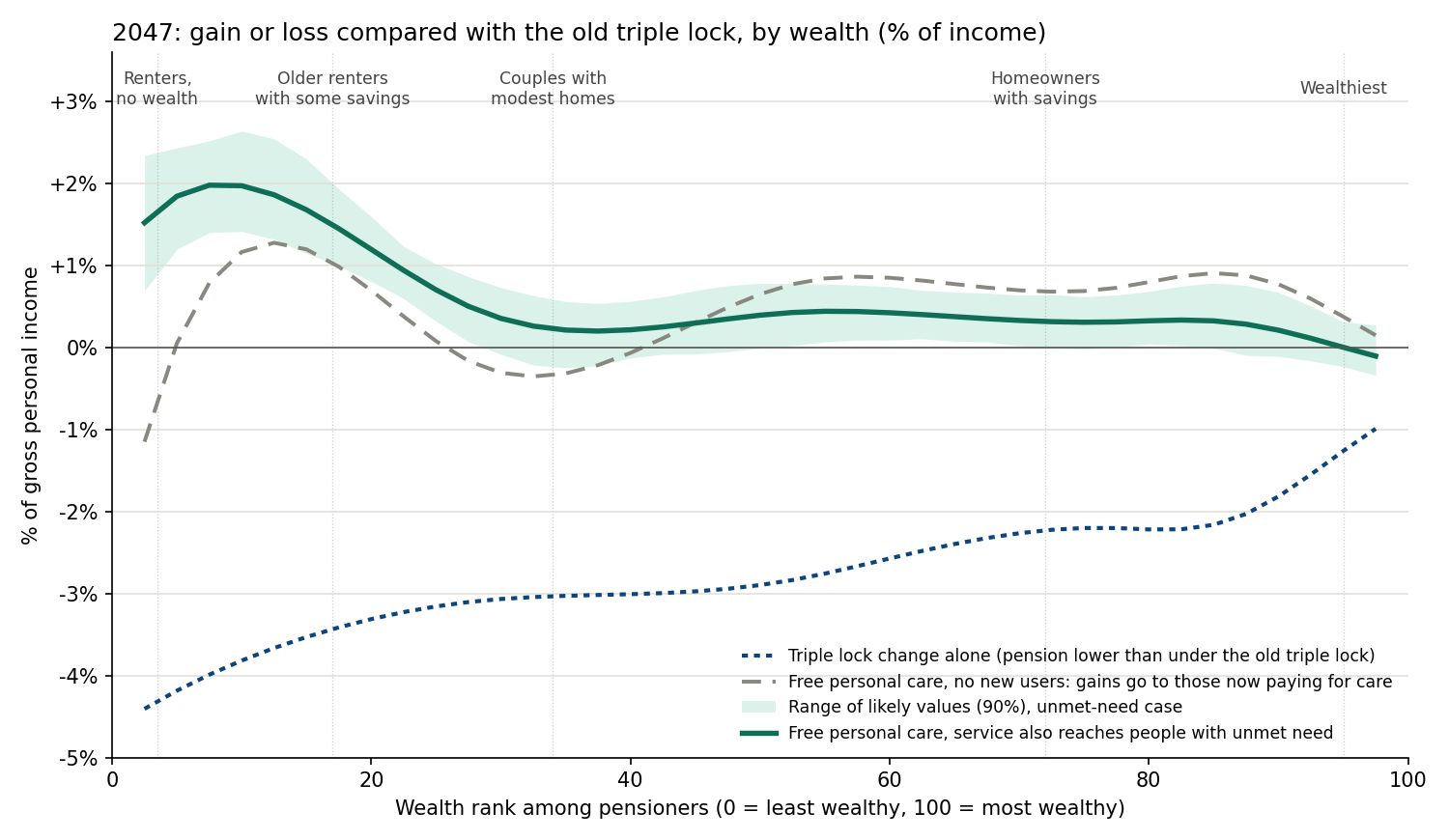
Notice here that the big gains for fairness start to appear if the National Care Service actually delivers on Burnham’s pledges. It has to significantly expand access to overcome losses at the poorer end of the pensioner population. There are also some potential losers around the poorest quarter of pensioners. As our illustrative examples suggest, these are likely to be couples, often relatively younger, currently making less use of the care system. A well-designed system should tread carefully here to avoid real costs.
Finally, this calculation doesn’t capture the intangible but genuinely felt benefit of offering real security later in life. This might be the strongest single argument for a National Care Service: that no one need worry about their later-life care needs being met.
3. Making the plan work
The National Care Service cannot be fully-funded on a plausible timetable from removing the triple lock alone. It will be decades before those notional savings add up. And, as the IFS points out, cancelling a pension increase that is yet to happen does not actually create new money for government – it’s a notional saving against spending the government would probably have made.
Two suggestions could help here, and address the challenge of ensuring fairness in old age:
Begin with abolishing charges. Abolishing council care charges for older people is affordable on this reform by the mid-2030s.
Raise revenue from wealth. Free care protects homes and savings, so those with significant wealth could contribute: capital gains tax aligned with income tax and a wealth tax for the very wealthiest would all help.
A National Care Service, with free personal care at the point of use, NHS-style, would be a huge, transformative change in how our care system operates at a time when our society is aging and many more of us and our families can expect to need care later in life. Andy Burnham has rightly been praised for setting out his vision for it. But it will need more than a change to the triple lock to fund it, alongside more ambitious changes to be a truly affordable change, and one that produces visibly fair outcomes.