

James Meadway
Last Thursday the government asked every household in the country to keep three days of supplies at home. The Be Ready checklist asks for bottled water, three litres per person per day, and food “with a long shelf life that doesn’t need refrigeration or cooking”. Storms, floods and power cuts are becoming more frequent as the climate heats, and a fracturing world adds cyberattacks and sabotage. It’s good that the government is waking up to this new reality.
But this individualized approach is entirely wrong. The checklist assumes that people can afford it. Trussell has warned that families struggling with the weekly shop have no margin to stock up. We estimate that nearly one in nine households, or 6.4 million people including more than two million children, cannot reasonably afford the government’s own recommended stockpile.
What it costs
Priced at the cheapest third of the prices the ONS collects in shops, a bare-minimum stockpile costs about £12 per adult for three days. That buys crackers, peanuts, peanut butter, tinned beans, tuna and fruit, dry cereal and nine litres of water. At typical prices it is nearer £20. Ready-to-feed baby formula adds about £12 per infant. This is food only, excluding anything like a torch, batteries, or wind-up radio.
Who can’t pay
If households less in savings than the stockpile costs, and their income after housing costs is below the poverty line, it’s safe to assume they can’t afford the stockpile. Using our model of UK households, we estimate that about 3.1 million households, or about one in nine (11%), cannot afford even this minimal stockpile. They contain about 6.4 million people, 2.1 million of them children. This is close to the 9% of households the DWP already finds food insecure.
The government’s advice is to build up gradually, “picking up an extra item or two when you can”. For a household below the minimum, barely scraping through, there is no “when you can”.
Where they are
A third of council tenants and a quarter of housing association tenants cannot afford the stockpile, against 4–5% of homeowners. Seven in ten are receiving Universal Credit.
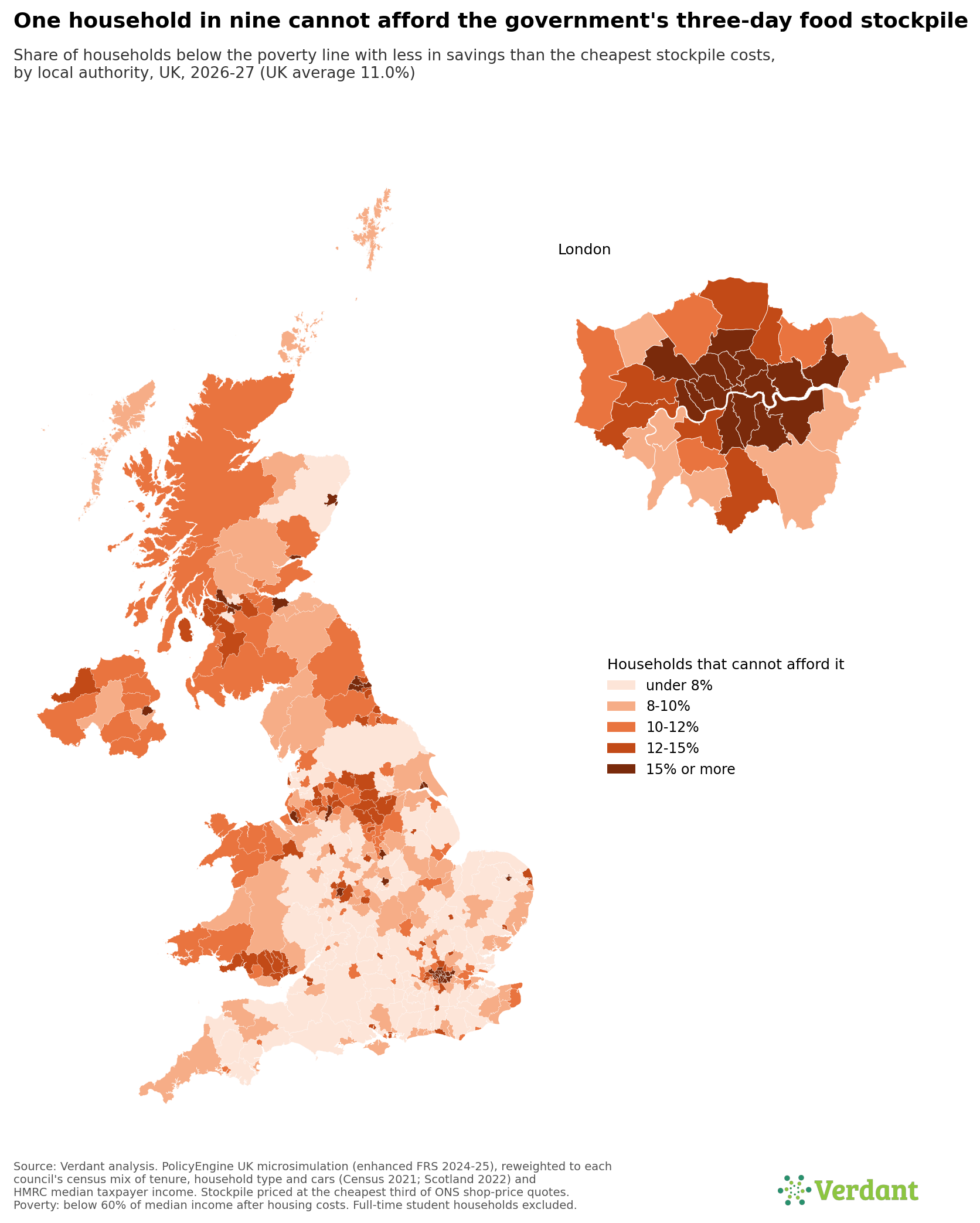
Glasgow tops the list of those left to the fend for themselves: more than one household in five cannot afford the stockpile. Inner London follows, with Newham, Hackney, Islington and Tower Hamlets at about 19% of households, then Belfast, Nottingham, Hull and Dundee at about 17%. The pattern is the familiar geography of deprivation: the big cities, west central Scotland, the South Wales valleys and the old industrial North.
Making it work
The current recommendation isn’t anything close to a national plan for resilience. The individualized approach fails millions of people. Instead, the government needs to recognize the need for resilience as a collective effort:
A one-off stockpile payment to the 3.1 million households would cost about £70m. But targeting is expensive and difficult. Paying it automatically to every household on Universal Credit would cost about £170m and still miss some households. Genuinely universal provision, with taxation to ensure the burden is shared fairly, is preferable.
Hold stocks and kits locally. Councils and community hubs could keep stock for distribution, funded through the Crisis and Resilience Fund.
Build the reserve behind it. A household’s three days should be the last link in a chain, with national food stockpiles as the first. Countries like Sweden are already building up their national food reserves, but Britain has held no national food stockpile since the mid-1990s.
Asking people to prepare is reasonable. Failing to provide any way to prepare is not.