
James Meadway
Why a freeze on rent is urgent
Renting in England has been getting less and less affordable for decades, and the last few years have been the worst of it. Estate agents Savills put the average renter's outgoings at 32.4% of household income in 2025, up from 30.4% five years earlier: the sharpest deterioration in rental affordability since at least 2006. Average rent across England reached £1,451 a month in July and is still climbing at nearly 4% a year. More than half of households on universal credit face a shortfall between their housing costs and their support.
Parliament has just legislated on the private rented sector without touching any of that. The Renters' Rights Act abolished “no-fault” evictions, amongst other changes, but left landlords free to charge whatever the market will bear. Other countries apply strict controls on what private landlords can charge, recognising the need to protect those who rent. England is unusual amongst richer countries in not having some form or rent controls. An OECD survey found that two-thirds of its members “regulate rents in some form”. Scotland, for example, has recently imposed a one-year rental freeze as a precursor to introducing a cap on future rent rises.
The most detailed recent work on doing something similar in England is Beth Stratford and Joe Beswick's Taking Back Control of Rents, published by UCL in July. Their first recommendation is a temporary freeze: rents held flat for a defined period, to let wages catch up and buy time to design something permanent: a “breathing space” for renters.
We costed what that would be worth to the people paying the rent: two years of frozen rents in England, starting this October.
How we worked it out
The ONS publishes average private rents for every local authority in England, monthly. JLL, the property firm, forecasts rents up 16.5% nationally by 2030 and 17.1% in London. Freeze rents, and the difference between those paths is money that stays with the tenant - it’s money they won’t now have to pay to the landlord. Apply it to each area's own rent and you get a figure for all 296 councils.
What it comes to
The average private renter in England would avoid paying £1,090 over two years, which adds up to £5.2bn nationally. The map below shows the variation across different local authorities.
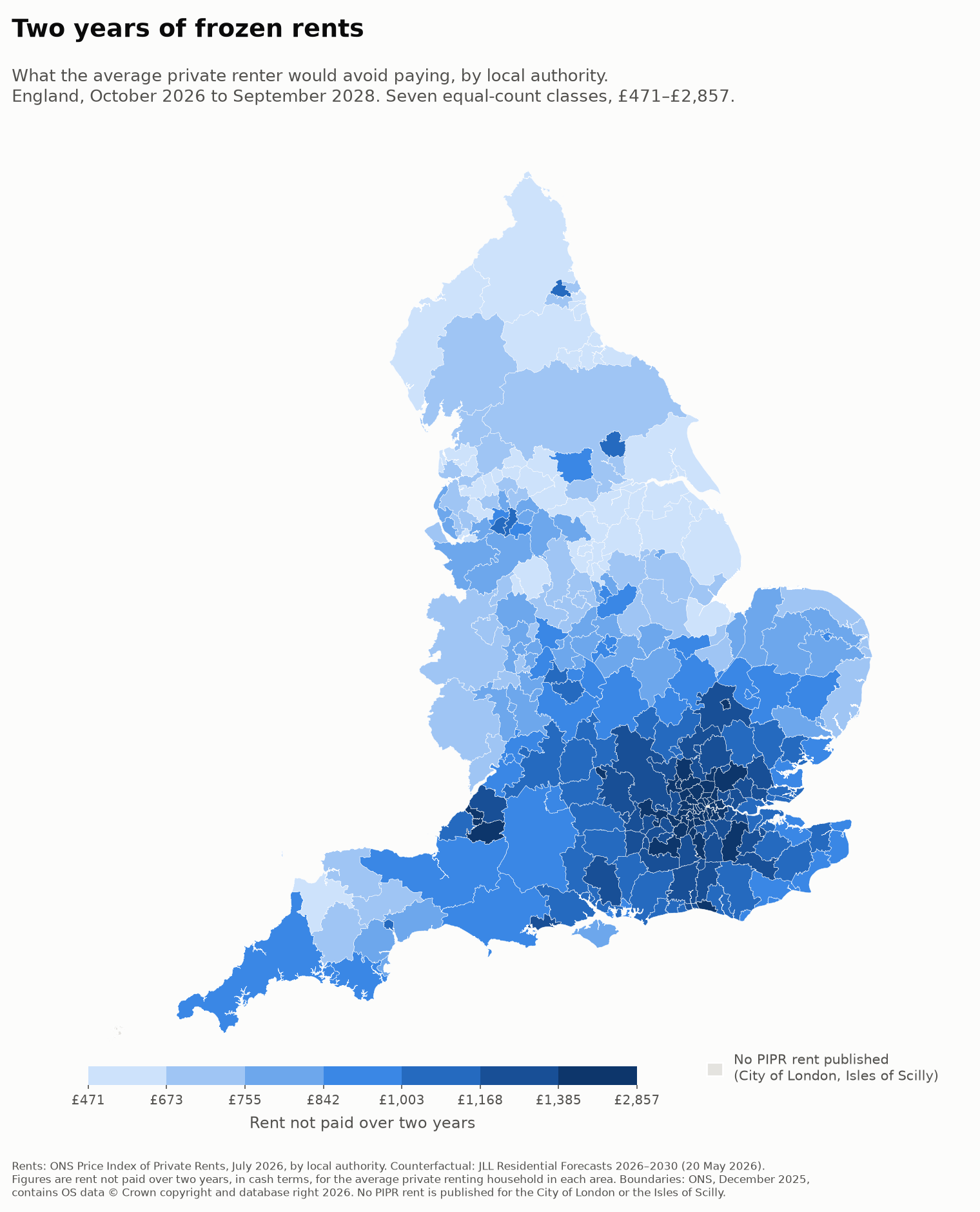
Unsurprisingly, it is London, where rents are highest, that the greatest savings can be made. Across the whole city, a two year rent freeze in London would save a private renter £1,722 on average, or £1.8bn in total. The map below shows the average saving in each London borough.
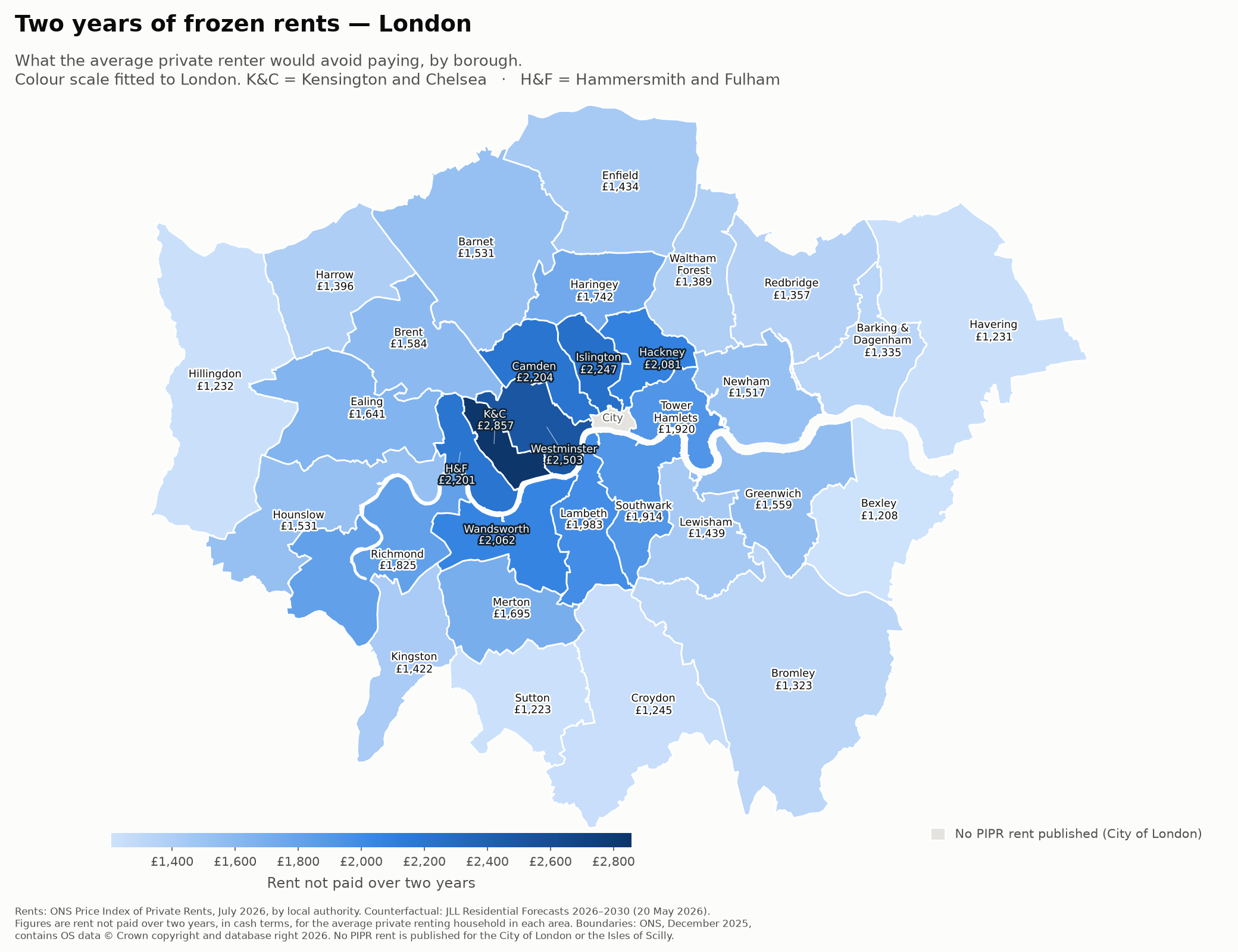
It’s the pressure-cooker inner London boroughs where the savings really add up, from Kensington and Chelsea in the West (£2,857), through Camden (£2,204) to Tower Hamlets in the East (£1,920).
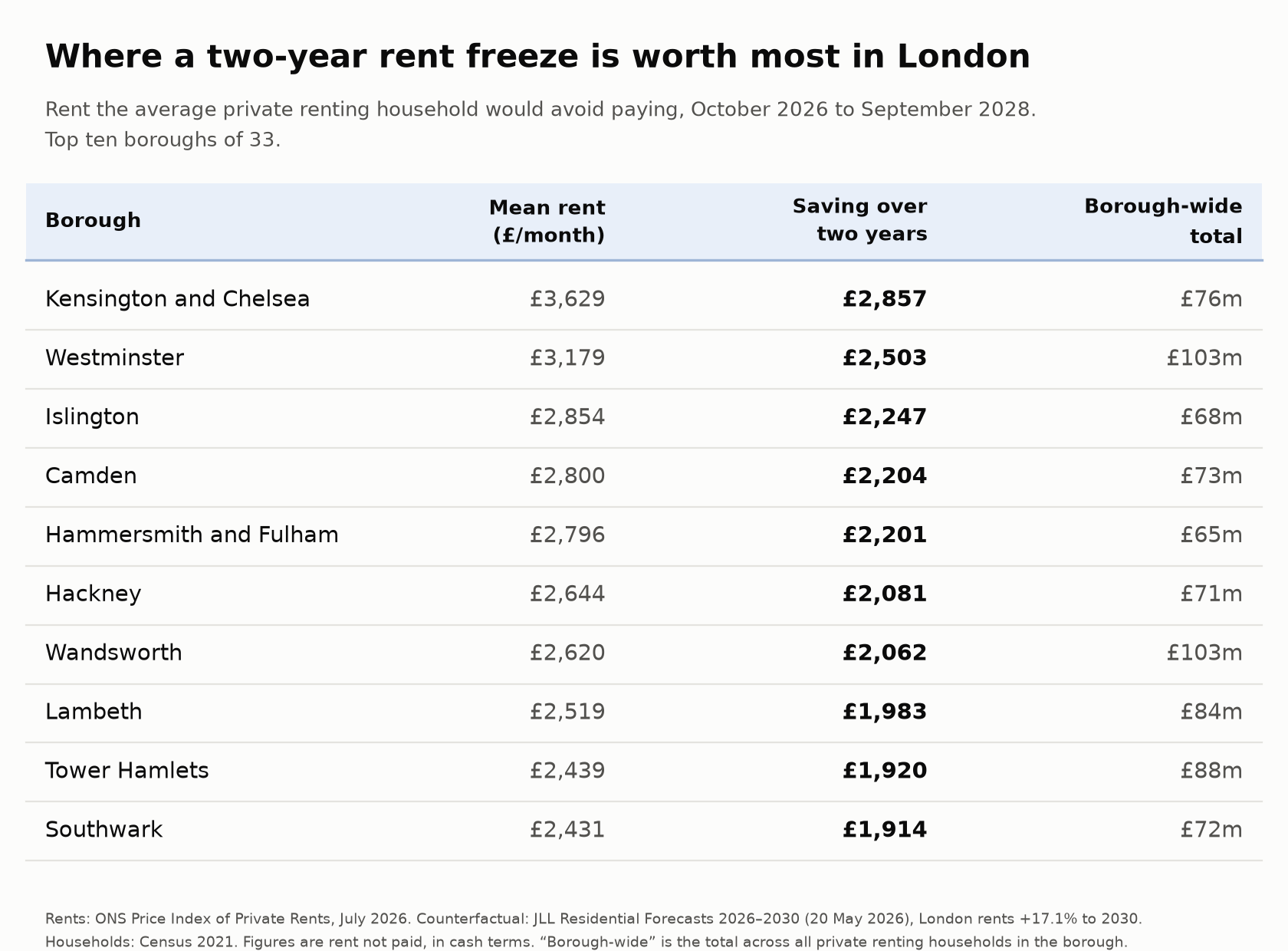
Of course these are figures for rent not paid, which is not the same as directly receiving more money. But it does mean avoiding a pressing, worsening cost. It’s also based on a forecast; we don’t know the future with certainty, so the true savings could vary. And being averages, individual circumstances will obviously differ, including whether someone is a Housing Benefit claimant. But we think this headline number is a good indicator.
Could landlords afford it?
Yes. A rent freeze leaves landlords who are able to rent at a profit today still making a profit. Where some might have problems is if interest rates rise in the future, but that’s in the hands of the Bank of England. Its Monetary Policy Committee is supposed to take account of economic sensitivities when setting interest rates.
However, the evidence from the UCL paper strongly suggests that rent controls could comfortably go much further. Using HMRC data obtained through freedom of information requests, the authors found that actually cutting rents by 10% would leave close to 98% of landlords still making a profit - even when interest rates are as high as they have been in the last few years.
The question of affordability often gets raised about rent controls. The best and most detailed evidence we have suggests that landlords have far more capacity to absorb not only freezes, but cuts.