
Andy Burnham tells us how he will deal with our old problems. But what about the new ones?
James Meadway
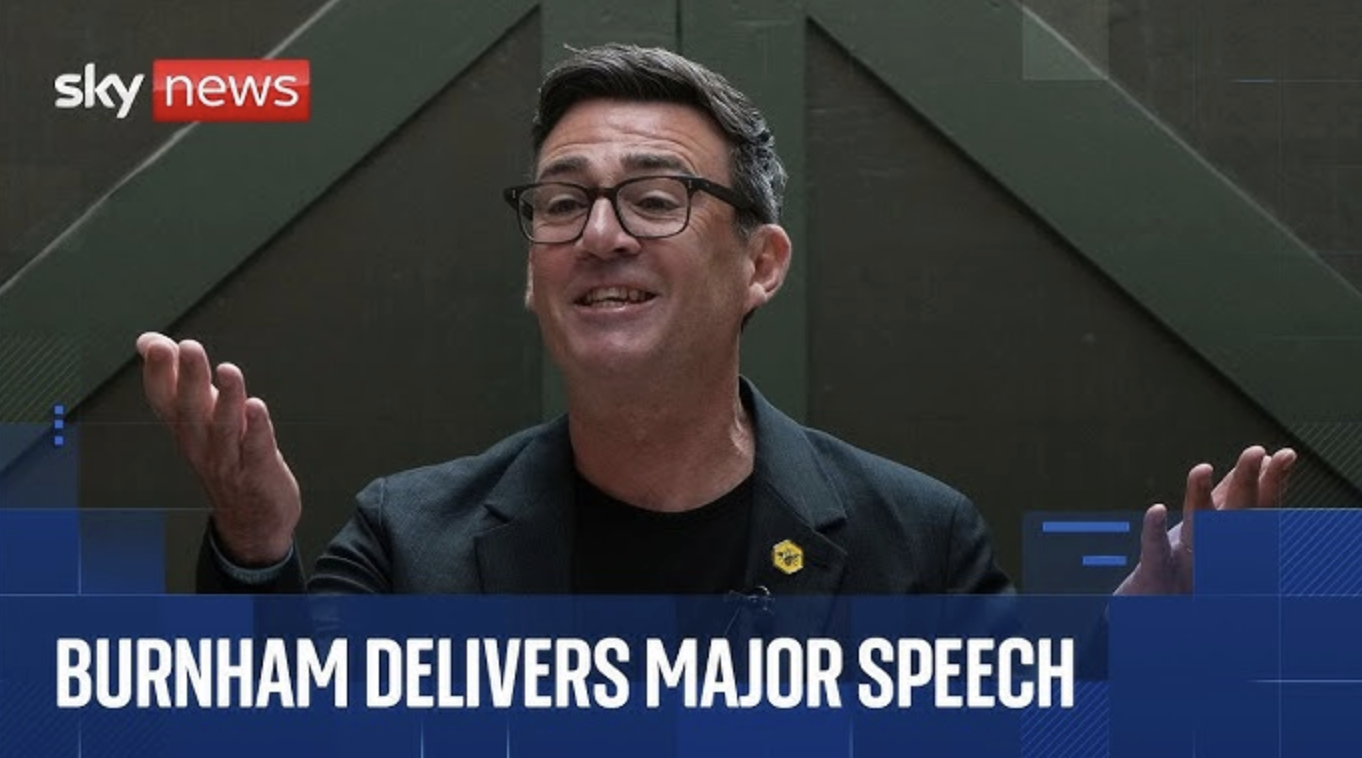
Andy Burnham, presumptive Prime Minister in waiting, has set out his vision for the country once he finally arrives in Downing Street, perhaps as soon as mid-July. There’s a great deal his speech at Manchester’s People’s History Museum that can be welcomed, as there has been in much of what Burnham has talked about in the last few weeks and months: the failures of privatisation and market control; the failure of austerity; the centralisation of power in Whitehall, and the Treasury in particular; the lack of investment across much of the country.
It’s a solid account of what has gone wrong with this country’s economy over the last few decades and if a lot of it will be familiar to some readers, that’s a tribute to the fact that the progressive critique of British capitalism has steadily been mainstreamed. It’s not unusual any more to hear the Treasury attacked for its excessive power and narrow vision, or to find the privatisation of essential services like transport and water criticised. Low investment is increasingly understood as the biggest single factor in Britain’s miserable recent economic performance, relative to other, similar economies.
The doom-loop
And it’s on investment that our economic doom-loop is most obvious. When governments fail to invest – when new railway lines are not built or when new powerlines are not constructed – that, in turn, makes businesses less willing to invest, too. And when businesses fail to invest that leads to lower growth which is then used to justify further cuts to government investment spending. Successive governments have fallen into this trap, with Chancellor Rachel Reeves being the most recent to announce cuts to investment spend in order to pay for significant defence expenditure increases.
Hefty economic shocks, like the 2008 financial crisis, Brexit, and the period of instability since the 2020 pandemic, have only accelerated the spiral. Britain today has significant government debt, a wide deficit, low growth and substantial dependencies on the rest of the world in the form of its food and energy imports. As a result, whilst governments everywhere are finding it more expensive to borrow since the pandemic, the UK government’s cost of borrowing has risen more than most, and every year over £110bn is now spent on interest payments – about the same, for comparison, as the entire education budget.
Breaking this will require a breach with the institutions that got us into this mess in the first place. That’s where Burnham’s criticism of Whitehall centralisation and the Treasury’s role come in. And broadly, he is correct: a failure to build (for example) the long-promised “Northern Powerhouse Rail”, let alone the farce of HS2, and countless other smaller failures and unmet promises across the country outside of London, has meant much of the country lagging further and further behind London and the South East. The Treasury solution to this, unthinkingly adopted by Reeves, is to try and do even more in London and the South East, on the grounds that success breeds success. And so Labour has, like so many governments before, promised a third runway at Heathrow (of limited real economic benefit) and to turn Oxford and Cambridge into a new “Silicon Valley”. (Diane Coyle and Marianne Sensier, in a brilliant empirical paper, call this the problem of the “Imperial Treasury”: a too-powerful central institution that is indifferent to the problems of distant provinces, thanks to its own internal accounting procedures.)
If Burnham is serious about breaking with all this, then that’s a very significant step away from Starmer/Reeves approach of hugging those same, failing Whitehall institutions ever more tightly. Promises to create a “Number Ten North”, or to devolve more tax-raising powers to local authorities, or to increase “public control” (if not, pointedly, public ownership) over water, energy and transport, or to push hard at delivering a massive expansion of council housebuilding all have the potential to become serious and significant failures of the past.
The shock of the new
But that’s the problem. Burnham’s speech could have been written at any point in the fifteen years since the financial crisis. Indeed, some of his lines on devolution and public control were notably similar to former Labour Shadow Chancellor John McDonnell’s from a decade ago (McDonnell, 2017: “the greatest transfer of power to the North since the Industrial Revolution”. Burnham, 2026: “the biggest rebalancing of power this country has seen”.) Some may even remember Boris Johnson’s enthusiasm for “levelling up”, with Andy Haldane, now named as a Burnham advisor, appointed to oversee a review of regional inequalities – one that amounted to very little real change.
Burnham’s problem is that this isn’t 2017. It’s not even 2022. It’s 2026. Borrowing costs for governments across the world have risen, and Britain’s more than most – reflecting real economic weaknesses. Inflation has soared, creating an ongoing cost of living crisis that is only set to worsen as the Iran War and the impacts of El Nino play out – notably on food costs. New research by Joseph Rowntree Foundation suggests the Iran War price impacts alone will leave households £740 a year worse off by the end of this decade. The last week has seen, yet again, temperature records broken by a blistering heatwave. None of this, bar an interesting passing reference to the need for “sovereignty” in food production, was dealt with by Burnham. Where, for example, was his support for the essential demand of national maximum working temperature?
Our national politics are stuck in a world that is fast fading away. The problems Burnham will face when and if he becomes Prime Minister will not only be those of the last decade, or even the last four. They will be the new uncertainties of a climate-shocked and geopolitically unstable world: of sudden surges in the prices of food and other essentials; of the new costs and miseries of extreme weather, from floods to heatwaves; of supply chains for essential goods broken by wars. This new world is unforgiving of delay: whatever plans our next Prime Minister might have for decade-long missions of national “rewiring” will be interrupted by repeated, violent shocks – and the growing public demands for protection against them.