
Beyond 'Increase Defence Spending': A Progressive Case for Security
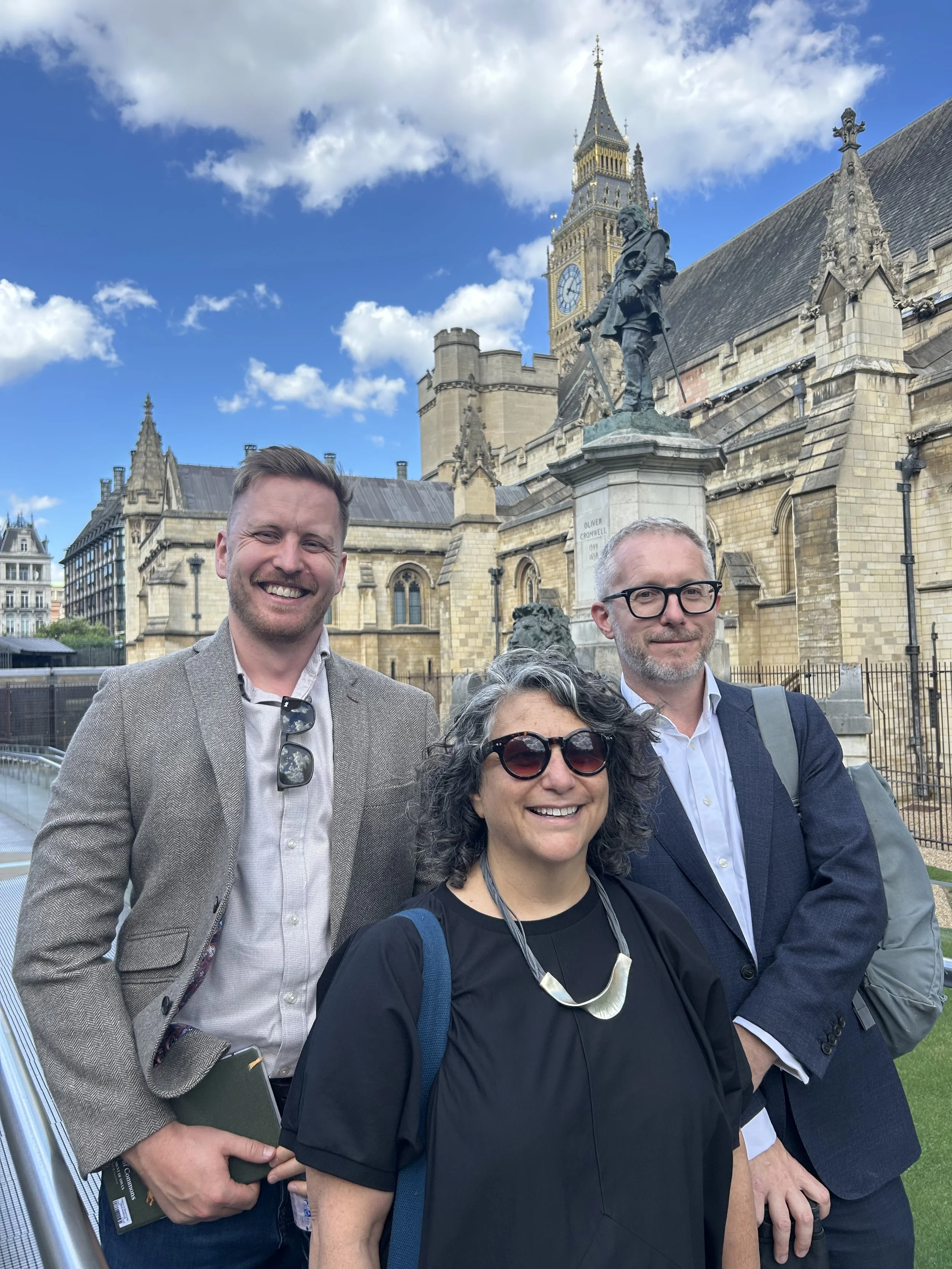
Tom Woolmore, Deborah Doane and James Meadway outside the Palace of Westminster
Guest blog by Tom Woolmore (Centre for Statecraft and National Security)
I ended last week feeling energised and, dare I say, a little optimistic. An unusual and tentative feeling for someone on the left, but I felt so with good reason.
I attended a Verdant national security panel discussion hosted by Clive Lewis MP at the Palace of Westminster, which reinforced my belief that progressives absolutely can and must have the difficult discussions required in these times of global instability, and we are entirely capable of coming up with the robust answers this country desperately needs.
There is clearly a growing interest on the political left in having serious, grown-up discussions about defence and security. Frankly, it's long overdue. Historically, progressives have struggle in this policy area. We’ve often fallen into the trap of either retreating into comfortable anti-war slogans or ceding the entire debate to the political right, leaving us without a comprehensive vision for keeping the country safe. But it's starting to feel like this might be changing. As the two mainstream parties are collapsing in the polls, there is a growing realisation that if we want to govern and protect the values of human rights, democracy and sustainability that we hold dear, we have to be willing to defend them.
This is why Verdant's national security research is so important. I am fortunate enough to have been given the opportunity to join their citizens’ panels as a commentator. I got to hear directly from members of the public about what security actually means to them. It was an enlightening experience, showing that the public has a deep interest in national security and a much more sophisticated understanding of risk than I believe the government gives people credit for. They engaged in discussions about the growing threat and impact of cyberattacks, the vulnerability of our energy grids, the fragility of our food supply chains, the dread of online disinformation, and the fundamental need to strengthen societal cohesion, so that communities can withstand unexpected shocks.
The conversations were far more nuanced than simply “we must increase defence spending”, and I think the UK government is doing the public a disservice by narrowing the national debate in these terms. The government's purported “whole-of-society” approach to defence seems to be an exercise in preparing the public to bear the material and psychological burdens of increased defence expenditure. To be clear: this isn’t a true whole-of-society approach.
Similarly, as we have seen in the overwhelmingly dismissive response to Dr Ellie Chowns MP’s criticism of large-scale spending on the nuclear programme, debate is unnecessarily stifled. Unilateral disarmament of nuclear weapons is not a publicly popular position, but that’s not to say that it is without merit: even Tony Blair hesitated when renewing Trident, saying in his book: “I could see clearly the force of the common sense and practical argument against Trident…On simple, pragmatic grounds there was a case either way. The expense is huge, and the utility in a post-Cold War world is less in terms of deterrence and non-existent in terms of military use.”
My personal position on this issue is irrelevant, but artificially limiting debate by pretending that the Green Party position lacks strategic coherence is simply wrong.
As demonstrated by Verdant’s citizens' panel discussions, we need a bottom-up approach to national security and resilience, and that process has to start with listening. For too long, national security has been treated as something done to the public, rather than something done in collaboration with the public. National security isn’t just about the size of a military budget (though hard capabilities matter); it’s about the strength and adaptability of our civil society, our infrastructure, and our democratic institutions. We cannot build a resilient nation without first addressing the insecurities people experience in their everyday lives.
Alongside assisting Verdant with this research and my work with the Centre for Statecraft and National Security, I’ve recently been elected convener of the Green Party’s Peace, Security and Defence Policy Working Group. This has provided a unique opportunity to facilitate debate among a group with a broad range of views. Formed of Green Party members with an interest in the policy area, the group's purpose is to research, develop, and propose new policies for the Party. Over the past year, there has been a noticeable influx of new members with a keen interest in improving security and defence policy, and many of the discussions have reflected the concerns we’ve seen in the citizens’ panels.
With this, I’m feeling great optimism about the upcoming Green Party Autumn Conference - although not without the usual apprehension that genuine, meaningful discussions may be derailed by internal party preoccupations. I truly hope the conference can serve as a vital forum for robust discussions about national security. I’ve co-authored and submitted a motion on security and defence, and I look forward to seeing how it is received by the wider party.
Similarly, the dawn of the Andy Burnham leadership of the Labour Party brings exciting new opportunities. It did not escape my notice that Clive Lewis MP, a well-known progressive and early supporter of Burnham’s bid for the leadership, has been championing a new UK security model akin to Finland's. A position that has the rare backing of both the existing defence establishment (at least rhetorically) and, increasingly, progressive circles.
The influence of the left is growing, and the vision for a values-based security model is becoming a contested space. This, in my view, is fantastic. But with this comes greater scrutiny and attention from both the public and the press. I hope we will stand up to it and use it as an opportunity to present ourselves as a serious, capable movement.