
Hard truths and short supplies
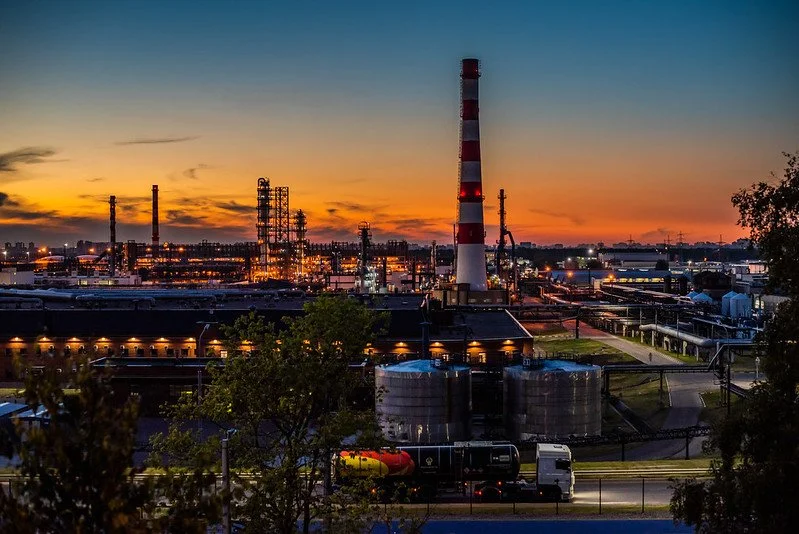
Moscow refinery. Kishjar/Flickr
James Meadway
Something I mentioned, speaking at Verdant’s “star-studded” launch last month was the need for a think tank to be able to speak “hard truths”. One of those new hard truths is that we live in a world of repeated shortages. And so the Independent reports:
“Lufthansa’s airline group has cancelled 20,000 flights in a bid to protect itself from the soaring cost of oil.
“Lufthansa Group announced on Tuesday 21 April that it will cancel flights over the next six months to save 40,000 metric tonnes of jet fuel, which it said had doubled in price.”
The immediate cause of the cancellations has been Iran’s blockade of the Strait of Hormuz, through which one third of the world’s oil and gas flows, in response to the US-Israel war. Price spikes and shortages have been spreading across Asia, the primary market for much of that flow.
But the shortfall in supply is now spreading into Europe, too, as the last tankers to make it out of the Strait before the closure arrive. Fatih Birol, the head of the International Energy Agency, warned last week that Europe has only “six weeks’ supply of jet fuel left”, as stocks held by refineries and airlines run dry. The clock is ticking downwards as we approach the continent’s holiday months.
Supply shortages like this pose radically different economic problems to those we have been used to. For decades now we have been used to living in a world, at least in the Global North, where in principle if something was available for sale, it could be bought. Globalisation, tying together producers, typically in the East, with consumers in the West through vast, world-spanning supply chains delivered the goods, literally and figuratively. Online shopping reinforced the trend: ultra-fast fashion giant Shein can supply clothes virtually on demand from its network of 150 manufacturers and giant warehouses, scattered across the globe.
But this decade has seen repeated shocks where this immense global supply system has broken down. The pandemic at the decade’s start was the most obvious; lockdowns and restrictions on movement across the world deliberately blocked parts of that system from operating. The creeping effects of climate change, worsening extreme weather across the globe, have been linked to shortages in olive oil and chocolate, amongst other foods. Typically, the market system has responded by jacking up prices – olive oil prices in Europe soaring 50% over 12 months, for example. If you had the money you could still buy the product; and tough luck if you didn’t, but this is how a market is supposed to work. The potential injustice lurking behind this is somewhat hidden by the market itself.
There are some supply disruptions that are so severe, however, that a product may not be offered at any price. The disappearance of tomatoes and cucumbers from UK shelves in early 2023 – the product of dire harvests in Morocco – was one instance of that. The hidden question of distribution is suddenly brought to the forefront.
Two responses to the impending jet fuel shortage have made that revelation almost painfully clear. The first was Andrew O’Brien, writing in UnHerd, where he claimed:
“Despite video and conference calling, there are still 5.3 million business flights every year that underpin Britain’s global trade…
“Inevitably, a jet fuel shortage will lead to the rationing of flights. This will not be popular with the public, but bankers and management consultants will have to be given priority over family holidays if we are to limit the economic damage.”
Or, as the article title says, “Why You Should Cancel Your Holiday to Save British Businesses”… “This will not be popular” could be an understatement.
The alternative was from the environmental charity Possible, quoted in the Daily Mail:
“Alethea Warrington, head of aviation at Possible, said: 'As disruption and instability from the oil industry continues, the government needs to take swift action to ensure that ordinary people's summer holidays are protected.
“They go on to suggest that ‘before accepting the cancellation of commercial flights, we need to ban private jets, luxury class flying, and curb ultra frequent flying.'
“Warrington explained how the charity felt it would be 'unacceptable' to allow the situation to reach the point where private jet flyers can continue their travels, but ordinary families cannot.”
One of the more mind-blowing stats I’ve seen in the last few years is the revelation (also from Possible) that one in ten flights taking off from a UK airport is now a private jet – so a ban on their flying will materially increase the amount of jet fuel available for holidaymakers.
You couldn’t put the question more starkly: do we favour business flights, and their (dubious) claims to benefit economic growth? Or do we allow families to take their well-earned holidays? It’s a value judgement, and I know where I stand.
But here’s the thing: the Strait of Hormuz closure is a huge event, affecting not only oil and gas supplies, but also blockading around one-third of the world’s fertiliser supply – essential for about half of the world’s agriculture. Food price surges and shortages are already being reported. And, looking ahead, who would want to bet on our climate-shocked and geopolitically turbulent world somehow miraculously becoming less unstable? The shocks and disruptions over time look set only to multiply, and worsen.
That means the hard truths of distribution will need to be addressed far more directly than we have become used to: short-term protections from price shocks for consumers and smaller producers and, in the longer-term, building more resilient, less fossil-fuel dependent systems for the supply of essentials like our food.